Institutional Effectiveness OLD Archive
About this Page
Within Higher Education, the term Institutional Effectiveness (IE) refers to the systematic, ongoing process of evaluating how well a college or university is achieving its mission and goals. IE relies on evidence-based data to drive continuous improvement across academics, administration, and student support.
OCCC’s Mission states: At Oregon Coast Community College, we equip students for success by providing educational pathways and supports in response to the evolving needs of Lincoln County and beyond.
The key components used to assess institutional effectiveness at OCCC are:
- Student Success Core Theme Indicators with Peer Institution Comparison
- The College Strategic Plan and Annual Planned Initiatives
- Service and Program Area Review Process (SPARE and SPARC)
- Assessment of Student Learning Outcomes.
Oversight and accountability for the assessment of institutional effectiveness at OCCC resides with the Institutional Effectiveness Steering Committee, the Vice President of Academic and Student Affairs, and ultimately the President.
Student Success Core Theme Indicators
Student Success Core Theme Indicators
With Peer Institution Comparison
Methodology: OCCC defines Mission Fulfillment within a single core theme: Student Success. The metrics comprising Student Success align with the metrics and methodologies of the Oregon Community College Student Success Center (OCCSSC) framework and dashboard (4 measures: Completing Gateway courses, Progress, Retention, Success) augmented by a local 5th measure, Belonging and Early Success. The Measuring Student Success chart further delineates subobjectives, achievement indicators, and thresholds for each. These metrics rely upon data sources currently most available, reliable, and useful for assessing institutional effectiveness. In assessing institutional outcomes for student success, OCCC considers student outcomes in year-over-year trends for OCCC students, as well as considering results for four other rural-serving Oregon Community colleges similar to OCCC.
Visit Student Achievement for most recent data on student success as defined above.
College Strategic Plan
College Strategic Plan 2023-2028
And Annual Planned Initiatives
OCCC’s Strategic Plan (CSP 2023-28) builds and expands upon the 2015-2022 “Five Big Ideas” framework. The CSP was developed via a year-long process engaging with the college Board of Education and employees, industry partners, Lincoln County School District, various data sources, and the Economic Development Alliance of Lincoln County.
Strategic Priorities for 2023-2028 are
- Students at the Center
- Careers Built Here
- Resourced and Ready
- First Choice, Best Choice
- Sharks Make Their Marks
Annual Planned Activities to Advance Strategic Priorities
Based on assessment results and other inputs, college leadership annually develops a list of planned activities to advance the five strategic priorities.
2023-2024 in CSP page 3
2025-2026 under development
Other Institutional Plans at OCCC
Service & Program Area Review
Service and Program Area Review Process (SPARE and SPARC)
OCCC’s Service and Program Area Review (SPAR) is intended to provide a comprehensive and in-depth analysis of program effectiveness, and a review of program alignment with Mission, Student Success, and the College Strategic Plan. SPAR encompasses the ongoing and systematic evaluation of all College instructional programs and service areas. A Comprehensive Service and Program Area Review (SPARC) is expected by program or service area every four years. The SPARC is supplemented by the Service and Program Annual Review and Evaluation (SPARE), which provides an annual progress report toward achievement of goals and outcomes.
The OCCC ASSESSMENT PLAN AND HANDBOOK describes and guides the process for completion of both SPAR reports. (Revisions to the 2022 Handbook are underway).
Sample completed SPAREs and SPARCs can be viewed below and include both Instructional and Service Areas.
Instructional SPARC example link (replace with actual name)
Instructional SPARE example link (replace with actual name)
Service Area SPARC example link (replace with actual name)
Service Area SPARC example link (replace with actual name)
Questions regarding SPAR processes should be directed to the Director of Curriculum Operations & Effectiveness.
Assessment of Student Learning Outcomes
Assessment of Student Learning Outcomes
OCCC assessment of learning outcomes includes formative and summative assessments. The combination of assessment methods enables the College to capture information about effective teaching and learning in the classroom and to assess how successfully students are able to integrate learning over time, after the completion of a sequence of courses or program. Summative assessments at the College include the assessment of learning outcomes associated with successful completion of a group of courses, either within a general education discipline (Discipline Learning Outcomes, or DLOs), or that fulfill requirements to complete a certificate or degree (Program Learning Outcomes, or PLOs).
Assessments are integrated and aligned through a curriculum outcomes mapping process, which identifies Course Learning Outcomes that relate to student achievement of Discipline and/or Program Learning Outcomes. Student achievement of learning outcomes is evaluated using four levels of achievement: Emerging, Developing, Competent, and Advanced. Faculty assess, evaluate, and document student achievement of learning outcomes and suggest and implement changes in the classroom to effect continuous improvement in teaching and student learning. Assessment results are shared, discussed, and evaluated in groups of faculty, including discipline and program faculty.
Fast Facts
Key institutional data are drawn from the Integrated Postsecondary Education Data System (IPEDS). For the full interactive dashboard, prepared in partnership with Linn-Benton Community College Institutional Research, visit the Fast Facts dashboard.
~600 FTE — enrolled students (2025–26 projected)
729 — enrolled undergraduate students (2022–23, IPEDS)
69% — female students
29% — students from minority backgrounds
11:1 — student-to-faculty ratio
62 — degrees and certificates awarded
IPEDS figures reflect 2022–23 academic year.
Enrollment Growth
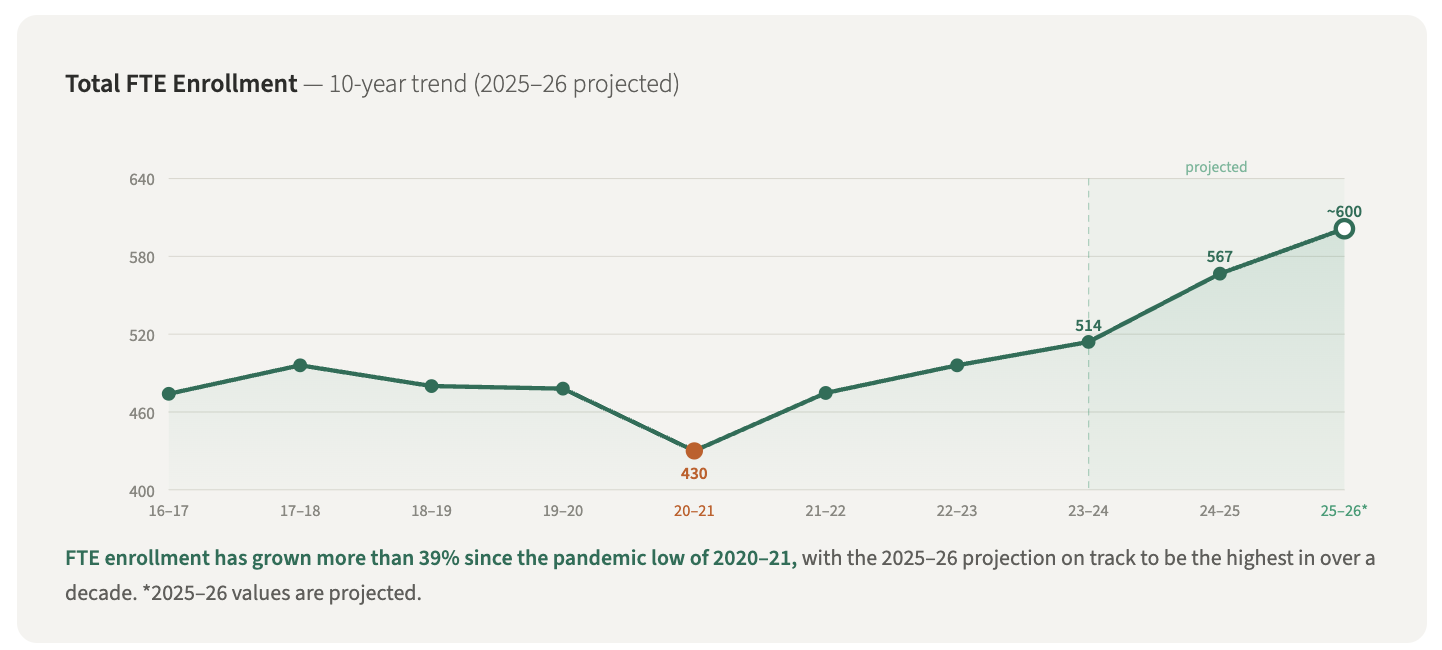
OCCC’s full-time equivalent (FTE) enrollment has grown more than 39% since the pandemic low of 2020–21, when total FTE reached 430. By 2023–24, FTE had climbed to 514; the 2024–25 figure reached 567, and the 2025–26 projection of approximately 600 FTE would represent the highest enrollment in over a decade.
Strategic Priorities
Priority 1: Students at the Center
– Continue to integrate the Academic and Student Affairs divisions
– Expand and diversify postsecondary course offerings at all Lincoln County high schools
– Develop and establish a framework for OCCC’s HSI attainment status
– Develop andragogical (adult learner) instructional approaches and support systems
Priority 2: Careers Built Here
– Significantly increase CTE capacity and enrollment through OCATT programming
– Through the HECC-recognized nursing consortium, pursue a four-year applied baccalaureate in nursing
– Pursue funding for modern facilities and equipment that enhance learning
– Regularly assess local needs in the trades and update the Environmental Scan
– Pending voter approval, begin facilities design and pre-construction planning of the OCATT Center
Priority 3: Resourced & Ready
– Successful recruitment and onboarding of the next OCCC President
– Strengthen campus culture through health, wellness, social activities, and intentional communication
– Implement a new server for backup, failover, and enhanced cybersecurity
– Implement year one of the Budget Alignment Process (BAP) to reduce reliance on one-time funds by at least 1%
– Fully transition automated financial services processes off SharkNet
– Make significant progress on deferred maintenance, including replacement of the Newport main building roof
Priority 4: First Choice, Best Choice
– Expand targeted outreach to adults, English-language learners, non-traditional students, high school students, and pre-apprentices
– Improve website navigability by redesigning the portal to career pathways and academic programs
– Enhance onboarding and expand orientation for new employees
Priority 5: Sharks Make Their Marks
– Conduct county-wide, community-specific engagement events to determine local needs and priorities
– Conduct post-election geographic analysis of bond measure support to document current perceptions of the college
– Continue enhancing the college’s role in county-wide emergency response, including updating the emergency supplies container infrastructure
Planning Documents & Reports
- Strategic Plan 2023–2028 — Full plan document (PDF)
- Fast Facts Dashboard — Interactive IPEDS data, prepared with Linn-Benton Community College Institutional Research
- Facilities Master Plan — Campus planning and OCATT Center
- Environmental Scan — Lincoln County community needs analysis
Assessment & Institutional Data
Institutional Data
- Student enrollment and demographics
- Program completion rates
- Transfer and employment outcomes
- Lincoln County workforce trends
- HECC Statewide Data & Reports
Assessment & Improvement
- Core Theme assessment results
- Program review process
- Student achievement standards
- Annual planned activities reporting
- Continuous improvement cycle
Accreditation
Oregon Coast Community College is accredited by the Northwest Commission on Colleges and Universities (NWCCU), the regional accrediting body for institutions of higher education in the seven-state Northwest region.
Accreditation documents, self-studies, and evaluation reports are available on the Accreditation Status page. Questions may be directed to the Office of the President.
Institutional data sourced from the Integrated Postsecondary Education Data System (IPEDS) unless otherwise noted, prepared in partnership with Linn-Benton Community College Institutional Research. FTE enrollment data from internal college records.