Welding
Welding Technology at OCCC
Earn a Welding Certificate and Jumpstart Your Career
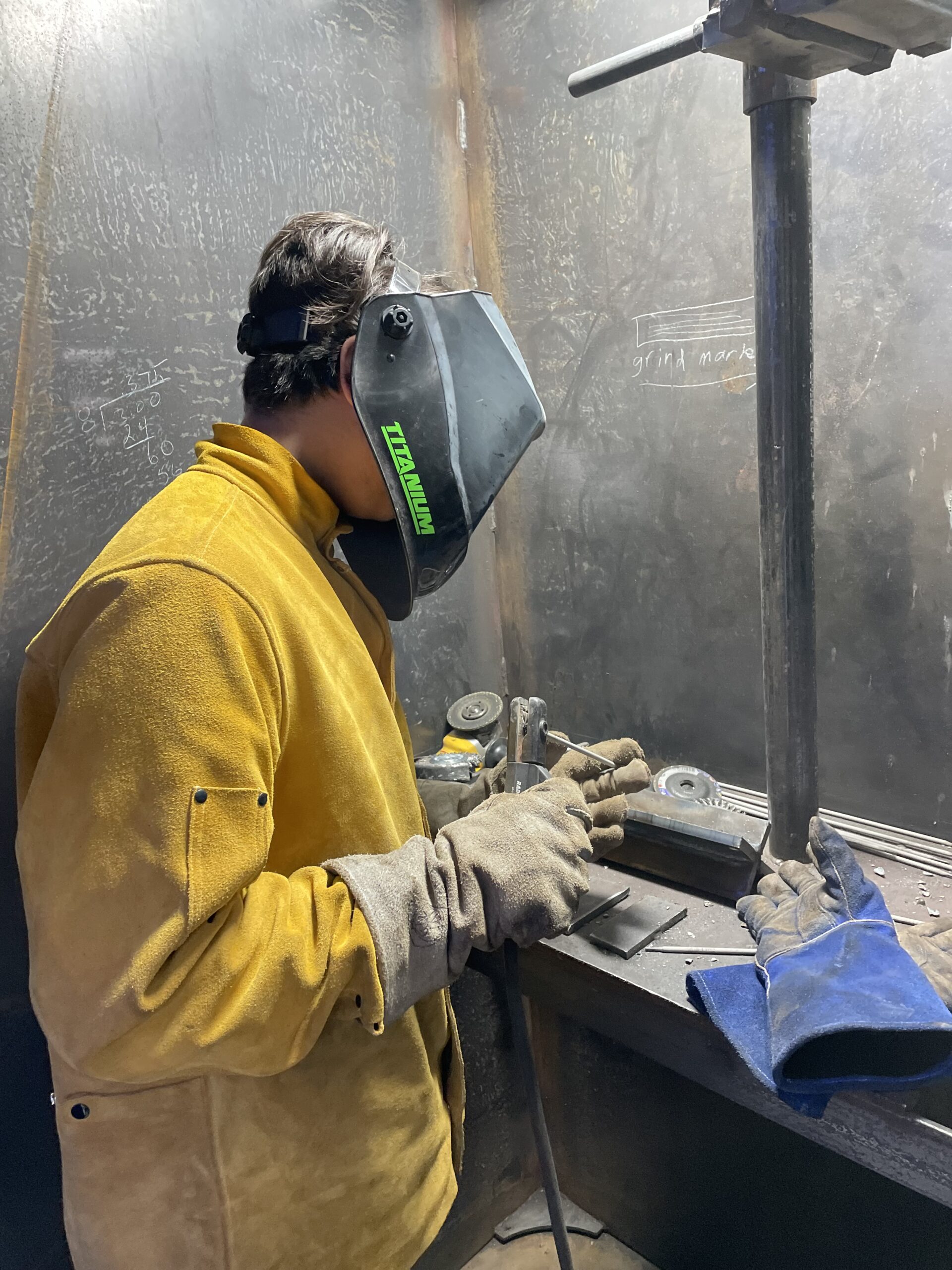
Oregon Coast Community College (OCCC) and Lincoln County School District (LCSD) have partnered with the Port of Toledo to create a state of the art Welding Training Lab at the Port of Toledo Shipyard. Additionally, a smaller facility has been developed at Taft High School in Lincoln City to serve students in the northern portion of the county.
Our welding faculty are dedicated teachers with real-world experience. Together you will learn in facilities developed to teach you the hands-on skills employers seek.
Currently, the OCCC Welding program offers students the ability to register for a one-year certificate program completing three courses per term (two hands-on and one lecture). Students wanting to complete in one year will enroll full time for Fall, Winter, and Spring terms. Re-entry, part-time students and students wanting to start in a term other than fall will have limited course options. Work with a Success Coach to develop a plan.
Oregon Coast Community College offers a Shipbuilding & Repair certificate. The certificate is comprised of four individual stepped certificates that culminate in one 48 credit hour certificate.


Introduction to Shipbuilding & Repair Certificate
Certificate Overview
Minimum 12 Credits. Students must meet all certificate requirements. The Introduction to Shipbuilding and Repair Certificate is a Career Pathway Certificate. All courses are contained in the Shipbuilding and Repair Certificate.
LESS-THAN-ONE-YEAR (12-44 CREDITS) CERTIFICATE REQUIREMENTS
- At least 6 credits must be earned at OCCC, all of which must apply to the certificate requirements.
- The final 6 credits that apply to the certificate must be earned at OCCC; the department chair may waive this requirement if the student can demonstrate currency in the field.
Students who successfully complete the Introduction to Shipbuilding and Repair Certificate will be able to:
- Function Safely in a welding environment
- Cut, prepare, and assemble projects to specified tolerances
- Interpret blueprints to accurately fabricate a product
- Weld common joint assemblies in all positions to prepare for certification in Flux Cored Arc Welding (FCAW) and Shielded Metal Arc Welding (SMAW).
Shipbuilding & Repair Certificate (48 credits)
Minimum 48 credits. Students must meet all certificate requirements. The Shipbuilding and Repair Certificate is a Certificate of Completion (CC1).
Comprised of four stepped certificates, which then culminate in one 48 credit certificate (Shipbuilding & Repair Certificate):
The Shipbuilding and Repair Certificate of Completion prepares students for careers in welding involving stick, MIG, and Flux Core Arc welding. One place where these skills are in high demand is in the maritime industry. Shipyards and ship repair facilities are expanding throughout the West Coast and along coastal river systems, and welding skills can be employed at port facilities, on ships at sea, and on oil rigs. Additionally, this Certificate offers a set of highly transferable skills that provides avenues to employment within multiple industries that employ welders (i.e., manufacturing, transportation, construction, energy and government sectors).
ONE-YEAR (45-60 CREDITS) CERTIFICATE REQUIREMENTS
- At least 12 credits must be earned at OCCC, 9 of which must apply to the certificate requirements.
- The final 9 credits that apply to the certificate must be earned at OCCC; the department may waive this requirement if the student can demonstrate currency in the field.
Certificate Outcomes
Students who successfully complete the Shipbuilding and Repair Certificate will be able to:
- Function safely in a welding environment
- Apply math and science concepts applicable to the fabrication process
- Communicate effectively with employers, co-workers and customers
- Demonstrate professional work ethics
- Cut, prepare, and assemble projects to specified tolerances
- Interpret blueprints to accurately fabricate a product
- Weld common joint assemblies in all positions in accordance with AWS D1.1 Structural Steel Code using SMAW, GMAW, and FCAW, and be prepared to take the applicable welding certification tests evaluated by a third-party agency.
Shielded Metal Arc Welding (SMAW) Level I Certificate
Note: This certificate is not Financial Aid eligible, but the larger Shipbuilding and Repair Level II certificate is Financial Aid eligible.
Certificate Overview
Minimum 12 Credits. Students must meet all certificate requirements. The Shielded Metal Arc Welding (SMAW) Level I Certificate is a Career Pathway Certificate. All courses are contained in the Shipbuilding and Repair Certificate.
LESS-THAN-ONE-YEAR (12-44 CREDITS) CERTIFICATE REQUIREMENTS
- At least 6 credits must be earned at OCCC, all of which must apply to the certificate requirements.
- The final 6 credits that apply to the certificate must be earned at OCCC; the department chair may waive this requirement if the student can demonstrate currency in the field.
Certificate Outcomes
- Function Safely in a welding environment
- Cut, prepare, and assemble projects to specified tolerances
- Interpret blueprints to accurately fabricate a product
- Weld common joint assemblies in all positions to prepare for certification in Shielded Metal Arc Welding (SMAW).
Shielded Metal Arc Welding (SMAW) Level II Certificate
Note: This certificate is not Financial Aid eligible, but the larger Shipbuilding and Repair Certificate is Financial Aid eligible.
Certificate Overview
Minimum 12 Credits. Students must meet all certificate requirements. The Shielded Metal Arc Welding (SMAW) Level II Certificate is a Career Pathway Certificate. All courses are contained in the Shipbuilding and Repair Certificate.
LESS-THAN-ONE-YEAR (12-44 CREDITS) CERTIFICATE REQUIREMENTS
- At least 6 credits must be earned at OCCC, all of which must apply to the certificate requirements.
- The final 6 credits that apply to the certificate must be earned at OCCC; the department chair may waive this requirement if the student can demonstrate currency in the field.
Certificate Outcomes:
Students who successfully complete the Shielded Metal Arc Welding (SMAW) Level II Certificate will be able to:
- Function Safely in a welding environment
- Cut, prepare, and assemble projects to specified tolerances
- Interpret blueprints to accurately fabricate a product
Weld common joint assemblies in all positions to prepare for certification in Shielded Metal Arc Welding (SMAW), and be prepared to take the applicable welding certifications tests evaluated by a third-party agency.
Career Outlook
Job Openings
Many trades employ welding skills. Employment prospects in the Northwest Oregon area (which includes Lincoln County) are moderate. The Oregon Employment Department forecasts 20 welding job openings per year through 2031.
Salary
The Oregon Employment Department reports that Northwest Oregon area (which includes Lincoln County) workers earn between $18.69 to $26.37 per hour. The average annual salary is $54,848.
Financial Aid Eligibility
Only the Ship Building and Repair Certificate is eligible for Federal and State aid.
Admissions Process
This is a limited entry program, and students are admitted on a first-come, first-serve basis. New students should complete the OCCC application and meet their Student Success Coach.
Required Materials
(Tool Bag = $485; Fitted Clothing Voucher = $320) Items cannot be bought separately. This equipment package is the minimum required for welders at most job sites. Students may not use their personal tools.
Tool Bag Items
Safety Glasses x2, Automatic Weld Hood, P100 Respirator Filter x2, Headgear, Face Shield, Silver Pencils, Paint Pen, 16″ Combination Square, 16′ Tape Measure, Slag Hammer, Wire Brush, 11″ C Clamp, Welpers, Flint Striker, 12″ Crescent Wrench, Angle Grinder, Wire Wheel x5, 1/4″ Grinding Disc x10, 36Grit Flap Disc x5, Duffel Bag
Fitted Clothing Voucher Items
Welding jacket, mig gloves, respirator, steel-toe boots: Students are to purchase a tool kit with initial supplies and a clothing voucher from the OCCC College Bookstore. The clothing voucher is used when the clothing vendor visits during the first class of fall term to properly fit safety clothing and boots. All tools and clothing are the students to maintain and use after the program. Personal clothing may be used with instructor permission. Use of personal clothing items does not reduce cost of the voucher.
Textbook
ATP Welding Skills 5th Edition Textbook & ATP Welding Skills 5th Edition Workbook.The most recent edition will be available through the College Bookstore. The textbook is used for each class each term.
How Do You Get Started?
Paying for School — You Have Options
Cost should never be the reason you don’t pursue a welding certificate. Your Student Success Coach can tell you about OCCC’s Financial Aid options. Schedule your meeting, below!
Your Next Steps
Your degree is waiting. Let’s not waste a moment!
Ready to start? Here’s what to do today:
Schedule an in-person or Zoom advising appointment with a Student Success Coach.
Apply for admission and register for classes
Additional Information
Disabilities
Oregon Coast Community College is committed to providing equal opportunities for students with disabilities throughout the College community. Students with documented disabilities are entitled to reasonable accommodations under Section 504 of the Rehabilitation Act of 1973 and the Americans with Disabilities Act of 1990. Our philosophy is to maximize your independence and self-reliance, providing a variety of support options to assist you in achieving your educational and/or vocational objectives. To receive services, you must submit documentation of your disabling condition(s) to the Vice President for Student Affairs. To initiate support services, please contact the Vice President for Student Affairs at 541-867-8511. Students are responsible for requesting, in a timely manner, accommodation and documenting the nature and extent of their disability.
Equal Opportunity and Non-Discrimination
The College prohibits unlawful discrimination based on race, color, religion, national origin, sex, marital status, disability, veteran status, age, sexual orientation, or any other status protected by federal, state, or local law in any area, activity or operation of the College. The College also prohibits retaliation against an individual for engaging in activity protected under this policy, and interfering with rights or privileges granted under anti-discrimination laws. In addition, the College complies with applicable provisions of the Civil Rights Act of 1964 (as amended), related Executive Orders 11246 and 11375, Title IX of the Education Amendments Act of 1972, Section 504 of the Rehabilitation Act of 1973, Americans with Disabilities Act of 1990 (as amended), Uniformed Services Employment and Reemployment Rights Act (“USERRA’), and all local and state civil rights laws. Under this policy, equal opportunity for employment, admission, and participation in the College’s programs, services, and activities will be extended to all persons, and the College will promote equal opportunity and treatment through application of this policy and other College efforts designed for that purpose.
Persons having questions about equal opportunity and nondiscrimination should contact either:
Vice President for Academic and Student Affairs, Kristina Holton
or
Director of Human Resources, Joy Gutknecht
Questions can also be mailed to their attention at 400 SE College Way, Newport, OR 97366.